Weekly Digest #153, 29 Nov 2025
In an AI-driven news ecosystem, creating value will not stem from producing content more efficiently or increasing the volume of content. Instead, real value will emerge from developing entirely new products, discovering innovative distribution models, or broadening the total addressable market.


Beyond the "News Artefact": The Brutal Economics of Liquid Content
AI isn't killing media; it's forcing a radical reinvention.
Currently, news media organisations attempting to adapt to AI are focusing on two primary strategies: Incremental Innovation and Content Defence. Incremental Innovation involves integrating AI into existing workflows, while Content Defence aims to protect content ownership rights through agreements with AI companies and requests for compensation.
However, in an AI-driven information ecosystem where content becomes a "liquid" commodity, most existing publications will struggle to sustain themselves under their current business models. Most publishers will find it challenging to compete with AI on scale and efficiency for commodity content. Only a select few publishers have enough brand differentiation to charge premium prices.
Prospective strategic models, such as the FT Strategies report, outline potential futures for news organisations to achieve sustainability. However, in the long term, these strategies are likely to be unsustainable for most publishers due to their current cost structures and operational practices.
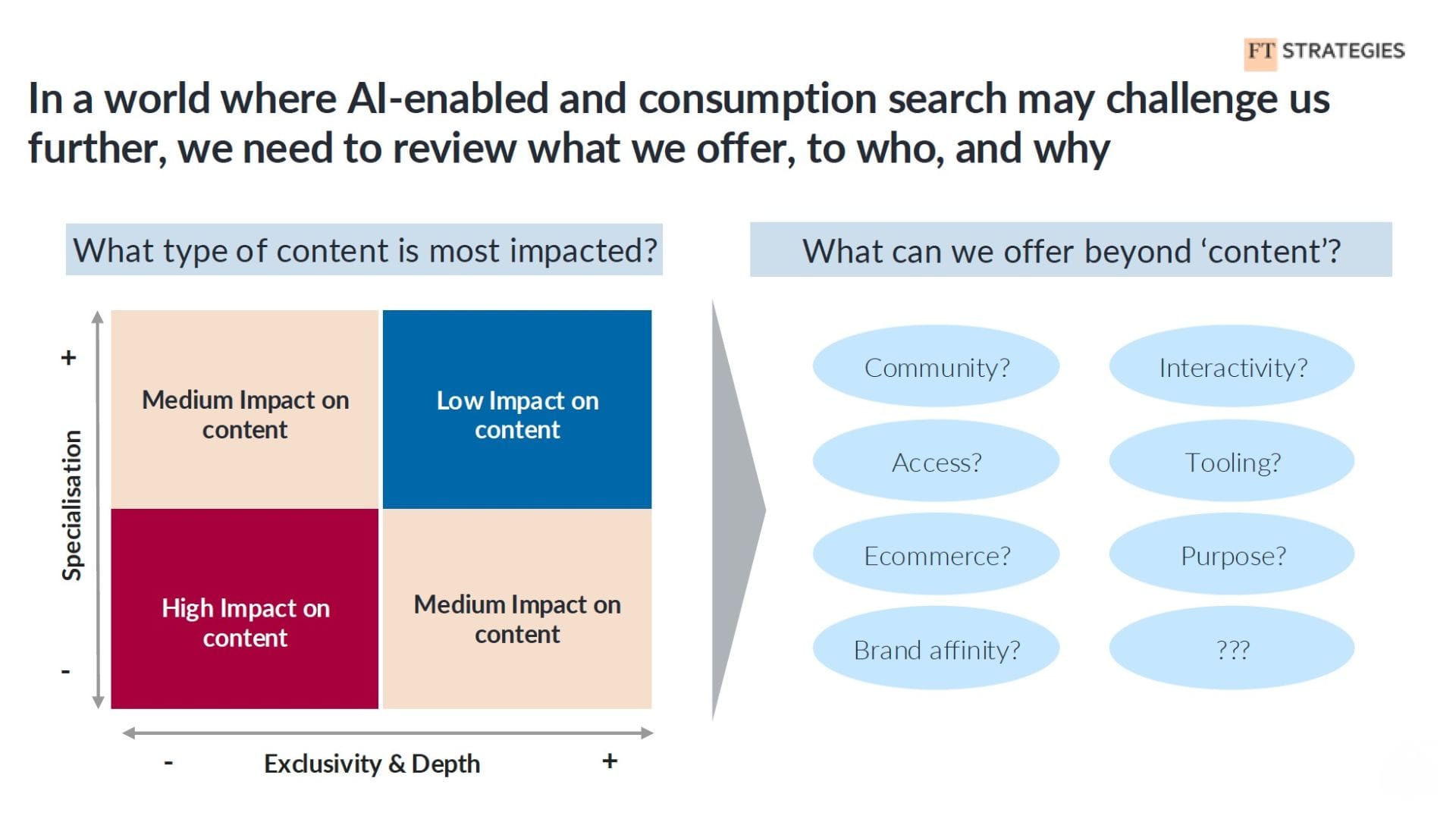
In journalism, creating value will not stem from producing content more efficiently or increasing the volume of content. Instead, real value will emerge from developing entirely new products, discovering innovative distribution models, or broadening the total addressable market. Publishers will need to focus on growth rather than merely optimising existing processes.
A common business saying is: "You can't achieve growth by cutting costs; you must create new value." One solution to this challenge lies in the paradox of an ecosystem where journalistic artefacts are commodified, while journalistic processes—such as truth-seeking, accountability, and sense-making—become more valuable than ever, both economically and socially. Although the artefact (the article) will still serve as a meaningful signal, the real power and actual value lie elsewhere: in the ability to confer legitimacy, determine what matters, independently seek the truth, and continuously correct the record.
So what if news media were to let go of the artefact as the product and productize the process instead? There are precedents. As software transitioned from packaged goods to cloud services, companies shifted from selling boxes of code to monetizing capabilities. Journalism needs a similar transformation while preserving its ethical foundation.
What new products or distribution models can journalism adopt to ensure sustainability in an AI-driven ecosystem? Francesco Marconi's AppliedXL serves as an excellent example. It utilises computational journalism algorithms to identify newsworthy events within healthcare and finance data streams. Rather than "creating content", its focus is on "selling the ability" to pinpoint significant information before it hits the news. In her post for Radically Informed, Shuwei Fang provides additional examples demonstrating that the future of journalism lies not in the byproducts of traditional article production but in developing standalone products, services, and infrastructure suitable for an AI-mediated world.