Weekly Digest #154, 7 Dec 2025
The marginalisation of professionally reported narratives demands a new architecture for trust, one that enhances the legibility of the information supply chain without resorting to censorship or a state-controlled “Ministry of Truth.”


AI Content Attribution: A Call for Market-Friendly Norms
Charting a Path Towards News Integrity
Over the past two weeks, a statement by French President Emmanuel Macron sparked controversy over bottom-up initiatives and the politically fraught concept of top-down, state-mandated labelling of news content amid widespread information chaos, where ambiguity threatens the very fabric of democratic debate.
The marginalisation of professionally reported narratives demands a new architecture for trust, one that enhances the legibility of the information supply chain without resorting to censorship or a state-controlled “Ministry of Truth.”
The most promising and durable solutions are those rooted in industry-led self-regulation, transparency, and the adoption of universal technical standards. Several distinct yet related initiatives have emerged as foundational components of this new architecture, moving from reactive content moderation to proactive source verification. The central dilemma is how to architect this clarity.
A multi-layered approach that combines unambiguous technical identification with voluntary, process-based certification offers a sophisticated and pragmatic pathway to reinforcing public trust. This requires a deliberate bifurcation of two fundamental questions: “Who is this source?” and “Does this source adhere to professional standards?”
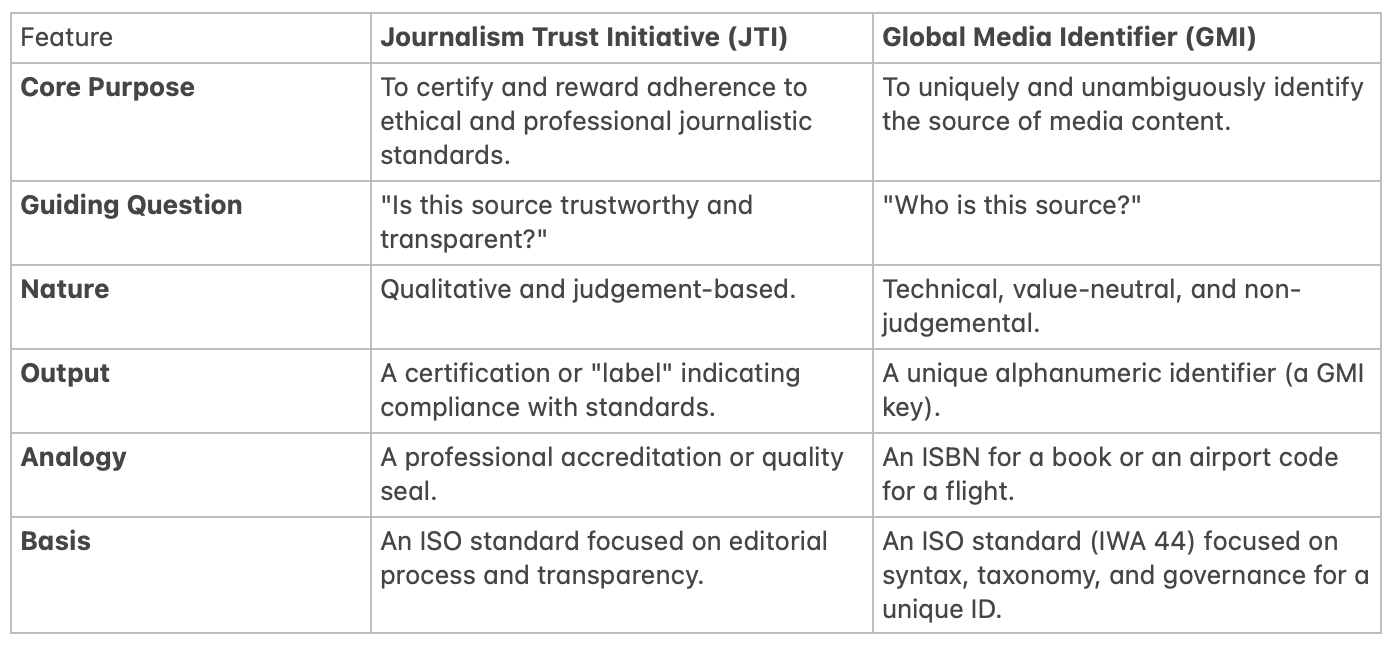
While the overarching goal is to enhance the legibility of the information ecosystem, the strategic approaches to achieving it can be divided into two distinct but complementary categories. The first is process-based qualitative certification, a "Trust Label" for people, which assesses and validates a news source’s adherence to professional standards. The second is neutral technical identification, a "License Plate" for machines, which provides a universal, unambiguous answer to the question of source identity without making any judgment about its quality. One system brings order for algorithms, ad-tech, and AI, while the other provides signals of transparency for citizens, journalists, and researchers.