Weekly Digest #157, 10 Jan 2026
The digital world is evolving in unpredictable and challenging ways, where visibility is achieved through uncomfortable strategies, trust is a paradox, brand perception is a technical signal, and the very foundation of our shared digital history is crumbling.

This week's Digest paints a picture of a digital world evolving in strange, unpredictable, and challenging ways, where visibility is achieved through uncomfortable strategies, trust is a paradox, brand perception is a technical signal, and the very foundation of our shared digital history is crumbling. We are entering a "Post-Naive Web."
Blocking AI Bots Might Actually Be Hurting Your Traffic. For publishers, the battle against AI has often seemed straightforward: lock down your content, block the crawlers, and protect your intellectual property. But new research, based on data from October 2022 to July 2025, reveals a different outcome for large news publishers, whose decision to block AI crawlers is linked to a significant drop in not only total website traffic (a 23.1% reduction) but also in real, human-generated traffic (a 13.9% reduction). In an AI-mediated world, complete invisibility to bots may also mean invisibility to people. However, it's not universal; the same research notes that mid-sized publishers sometimes saw a traffic increase, suggesting that AI visibility strategy is not one-size-fits-all and depends heavily on a publisher's scale and authority.
AI Adoption is High, But Trust is Low. Ezra Eeman's trend report pictures a “post‑naive web” where AI adoption is high, but trust is low, pushing news and content creators to design systems where trust is explicit infrastructure, not an assumption. The Adoption/Trust paradox highlights the messy reality of AI's current capabilities versus its futuristic promise. We're leaning on systems we inherently don't trust to be correct. This tension reveals that simply building bigger, more powerful models isn't the answer to creating real-world value. The path forward is more nuanced."If bigger models alone don’t deliver better results, progress needs a different approach. More value is emerging from combining models, adding structure, and building systems that iterate and self-correct.
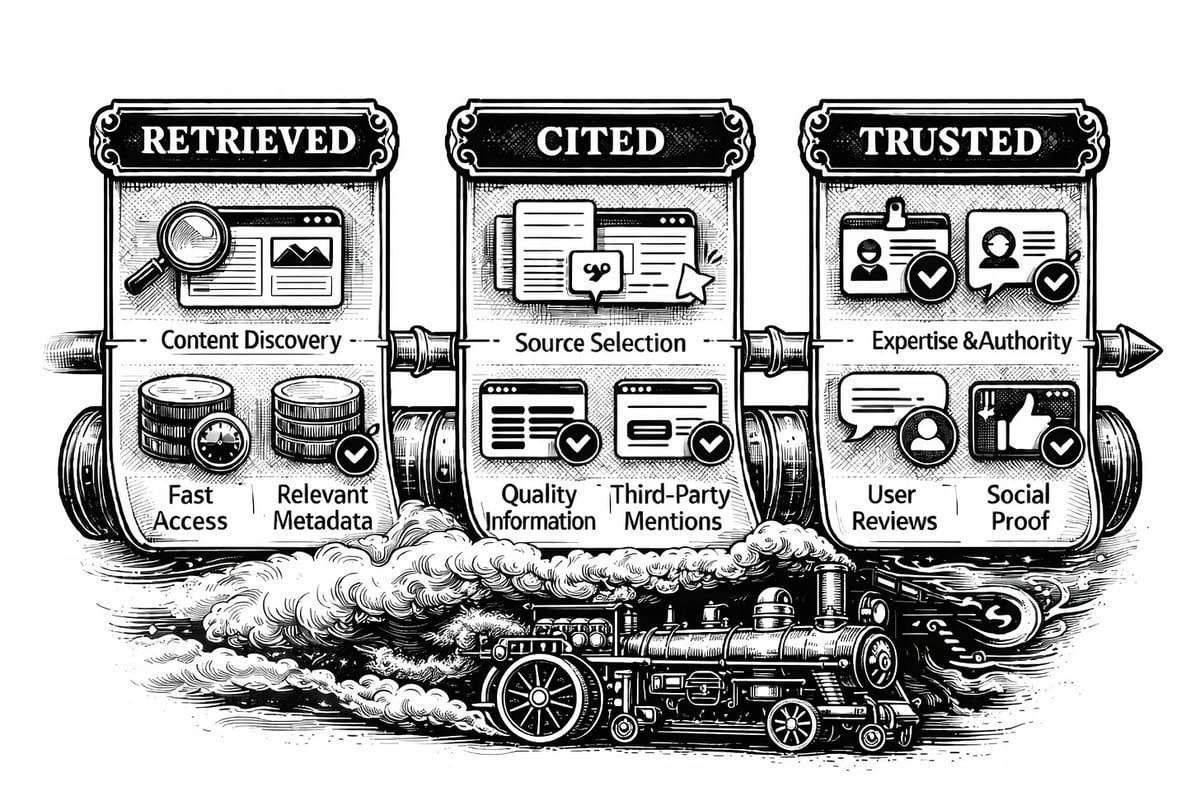
Your Brand’s Vibe is Now a Technical SEO Factor. For years, brand-building and technical SEO have lived in separate worlds. One was about perception, reputation, and marketing "fluff." The other was about crawlers, keywords, and code. That division is now officially over, according to Kevin Indig's "State of AI Search Optimisation 2026" report. A brand's long-term reputation is now a direct and critical technical ranking factor. With 85% of brand mentions in high-purchase-intent AI searches coming from third-party sources, your brand's vibe is no longer just a marketing concern; it's a core component of technical search optimisation. This represents a fundamental shift in optimisation priorities: old metrics like PageRank are giving way to new ones, such as 'Selection Rate' in an AI model, and on-page keyword density is being superseded by external validation on platforms like Reddit.
The Web You Grew Up With is Literally Disappearing. Have you ever clicked a link in an old article only to find a dead page? This phenomenon, known as "web rot," is accelerating at an alarming rate. Axios, citing Pew Research, reports that approximately a quarter of all web content from 2013 to 2023 has vanished. This creates a serious two-fold problem. For users, it leads to confusing and broken search results, turning the web into a digital graveyard of dead ends. But on a deeper level, it degrades the quality of the data pool used to train the next generation of AI models. As the historical internet disappears, AI is being trained on an increasingly shallow, incomplete, and potentially less reliable version of human knowledge, with profound implications for the future quality of information itself.