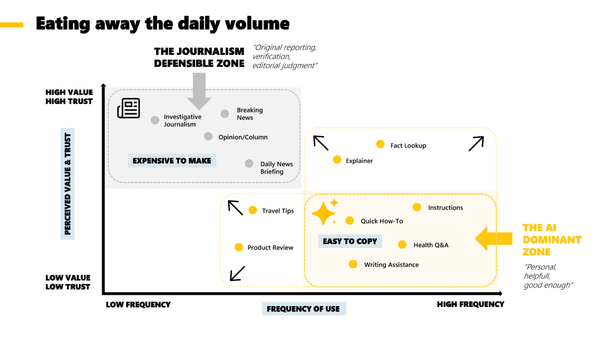
Weekly Digest, Issue #176, 6 June 2026
In the media ecosystem, major players must decide whether to extract resources or invest in diversity and complexity. Collective action is not about the strong helping the weak, but about preserving the foundation on which all depend.

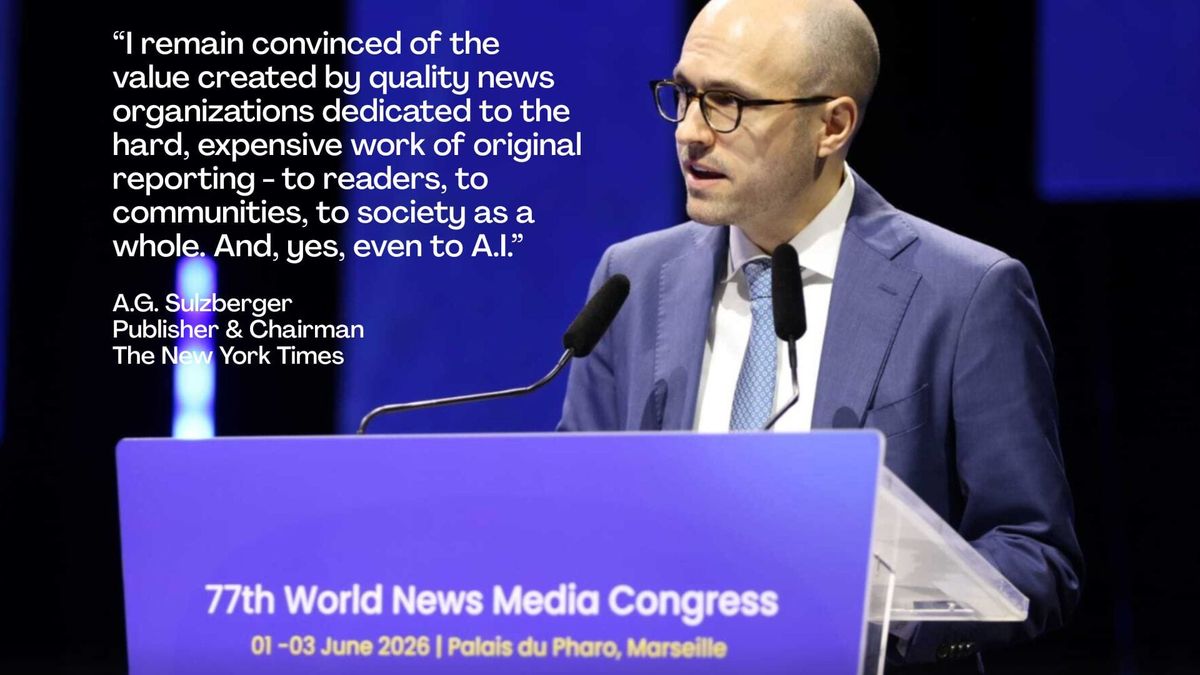
One highlight of WAN-IFRA's World News Media Congress 2026 was AG Sulzberger’s keynote, which strongly encouraged publishers to work together and support one another. This message really resonated with me, as it aligns with my own experiences with WAN-IFRA over the past fourteen years.
How AI’s "Original Sin" is Strip-Mining the Architecture of Reality
Artificial intelligence did not emerge as a simple tool but as a transformative force. ChatGPT reached 100 million users within months, marking the fastest adoption of any consumer product and redefining expectations for technological progress. However, this rapid rise conceals an "original sin." For two decades, the open web operated under an uneven agreement: tech platforms offered distribution in return for content produced by others. On June 1, 2026, at the WAN-IFRA World News Media Congress, A.G. Sulzberger, publisher of The New York Times, warned that this agreement has been unilaterally broken. We are moving from an era of imperfect cooperation to one of digital exploitation, where fact-based, first-hand reporting, the foundation of the “public square”, is being consumed by the very technologies it supports.
The Cost of Truth vs the Price of Compute
To grasp the extent of this issue, consider the core components of artificial intelligence: talent, compute, energy, and data. Industry leaders invest heavily in the first three, offering substantial compensation to engineers, funding specialised hardware, and covering significant energy costs. They would not steal hardware or electricity. Yet, when it comes to data, ethical standards often fail. The term "data" minimises the reality that, in news, it represents significant human effort and risk.
In 2025, The New York Times invested over $2 billion in its newsroom, with coverage spanning all 50 states and 155 countries. At any time, 70 journalists and support staff were present in Ukraine, often risking their lives to report accurately. In contrast, AI companies use this "data" without consent or compensation, extracting the value of 175 years of journalism to develop competing products.
"Their hijacking of the public square is made possible by the original sin that animates their A.I. products, a brazen theft of intellectual property that has occurred at an unprecedented scale." - A.G. Sulzberger.
Tech giants strip-mine news websites without permission or compensation. They repackage these stolen goods as their own, siphoning off audiences and revenue that would otherwise go to the news organisations that created this work.
From Symbiosis to Parasitism
For years, search engines like Google functioned as a lighthouse. While Google captured the lion's share of advertising dollars, it at least directed users toward the source, providing a path for publishers to survive through ads or subscriptions. But the new paradigm of generative AI represents a fundamental shift from a distribution engine to a replacement engine.
The current trend is clearly exploitative. Research shows it is now 10 times harder to get a Google user to click a link than it was a decade ago. Competing AI models that summarise news rather than direct users to it generate 96 per cent less referral traffic than traditional search. The aim is no longer to guide users to news, but to keep them within the chatbot interface. As a Microsoft researcher noted, Large Language Models are designed to "use their training data to substitute for the paid labour of those who created said data." This is ironic, as AI models depend on the journalism they undermine to remain accurate. Executives acknowledge this, with five of the top ten training sites for leading LLMs being news publishers. As a Microsoft Vice President stated, “Premium content meaningfully improves response quality.” High-quality journalism is essential to prevent AI from devolving into a cycle of misinformation.
The $11 Trillion Disconnect
The economic gap between content creators and AI companies has become extreme. The six largest AI firms are valued at $11 trillion, over three times France's GDP. In 2025, private AI investment in the United States reached $350 billion.
Yet, despite this cathedral of wealth, the foundation of labour is being starved. Current estimates shared by Sulzberger suggest that less than 0.5 per cent of AI investment goes toward compensating the people and companies whose intellectual property enables the technology. The industry is building an unimaginable future of profit on the ruins of the creative professions it has plundered.
Civic Commons
The threat extends beyond economics to civic life. Sulzberger describes this as a "tragedy of the civic commons," a breakdown of the shared factual foundation essential for democracy. In the past two decades, the United States has lost 75 per cent of its journalists and over 3,000 newspapers. Many areas now lack any local reporting.
When the source of shared facts dries up, the public square doesn't just fill with lies; it sinks into a state of "paranoid vigilance" where nothing is trusted. Here, Sulzberger invokes the wisdom of Hannah Arendt: the goal of a constant stream of misinformation is not to make people believe a lie, but to ensure they "no longer believe true things." This is the descent into nihilism, where citizens, exhausted by the "tsunami of slop," simply disengage from reality. Margaret Atwood’s haunting description of being "murdered by my replica" has become the epitaph for the truth in the digital age.
Reclaiming the Value of Information
To address this challenge, we must reconsider the belief that "information wants to be free." For years, technology companies have cited only the first part of Stewart Brand’s quote. The second part is equally important: "Information wants to be expensive, because it’s so valuable, the right information in the right place just changes your life." Reclaiming this value requires a decisive shift in the news industry from fragmented responses to unified action. We must establish clear, non-negotiable terms for a new social contract, including:
- Absolute Transparency: AI companies must disclose when and how they use copyrighted work.
- Mandatory Bot Identification: Bots must identify themselves and respect the explicit restrictions of the websites they scrape.
- Legal Responsibility: Tech companies must bear the same legal responsibility for defamation and falsehoods as the news organisations they harvest.
The Tsunami on the Horizon
We are witnessing the initial stages of a technological shift that may progress more rapidly and have greater impact than the advent of smartphones or social media. If current trends persist, the public square could be replaced by automated systems that rely on outdated information, lacking human verification.
Can society endure a future where those who investigate, witness events firsthand, and verify facts are replaced by models that process only existing information? If the value of journalism continues to be diverted from its creators, we risk losing not just an industry, but our connection to reality.
The "Lone Wolf" Dynamic at play, once again
In response to Sulzberger's call for collective action, the international coalition SPUR - Standards for Publisher Usage Rights - announced a major expansion at the World News Media Congress in Marseille. Founded by five leading British media outlets, SPUR now includes 36 publishers and organisations worldwide. Its main goal is to set technical standards for how AI systems use journalistic content. This is a proactive effort to ensure publishers receive fair value from the AI economy.
Despite this progress, the coalition risks facing resistance from a major industry player. Louis Dreyfus, CEO of Le Monde - the first French media outlet to sign a multi-year partnership with OpenAI in March 2024 - has expressed reservations about the coalition’s value and origins. Dreyfus's position is nuanced but readable: he does not reject SPUR on principle but reserves judgment on its concrete usefulness for Le Monde, which already has agreements. Despite SPUR clearly stating that it is not a collective licensing organisation, with founders and members retaining full autonomy over their own commercial relationships, he's also concerned about the potential incompatibility with his freedom to negotiate. He says he is watching SPUR closely, maintains relationships with its founders, but cannot yet see what membership gives a publisher that already has direct platform relationships.
“Do we need to pay a fee somewhere to exchange information? Do we have to pay to establish technical standards?” asks Louis Dreyfus, Chairman of the Board of Le Monde Group. “I completely understand that publishers who started later or don’t have the critical mass say, ‘I need to be part of this.’ But we’re not exactly at the same stage of development.” “It’s clear that you have the major British publishers and then a whole host of medium-sized publishers. If it’s a consortium of British publishers, that’s fantastic, but I don’t know if I have a place in it.”
In a biotope, no one survives alone
The success of any individual publisher, including market leaders, relies not only on the performance of its paid model and great journalism, but also on a broader information ecosystem, a biotope in which all participants contribute. This interdependence brings specific responsibilities acknowledged by founding members of the SPUR coalition.
A biotope is an ecological unit in which each organism has its own niche. While the food chain may seem hierarchical, it is actually circular: energy flows up, matter flows down. Remove one link and everything collapses. The lion needs grass. Not directly, but the zebra it hunts lives only thanks to grasses. These grasses grow thanks to nitrogen-fixing bacteria, fungi, pollinators, and soil-aerating worms. Remove the bees, a “small” actor, and the vegetation collapses within a few seasons. The lion dies afterwards.
Coordination: The flywheel of economic growth
"What really matters are the cascading effects that arise when coordination unlocks entirely new possibilities". In his essay, "Reshuffle", Sangeet Paul Choudary argues that "AI's economic impact comes not from how it performs a task, but from how it restructures the system in which it operates - letting domains, teams, and tools coordinate where they couldn't before". The news industry's situation under AI is almost a textbook illustration of Choudary's framework.
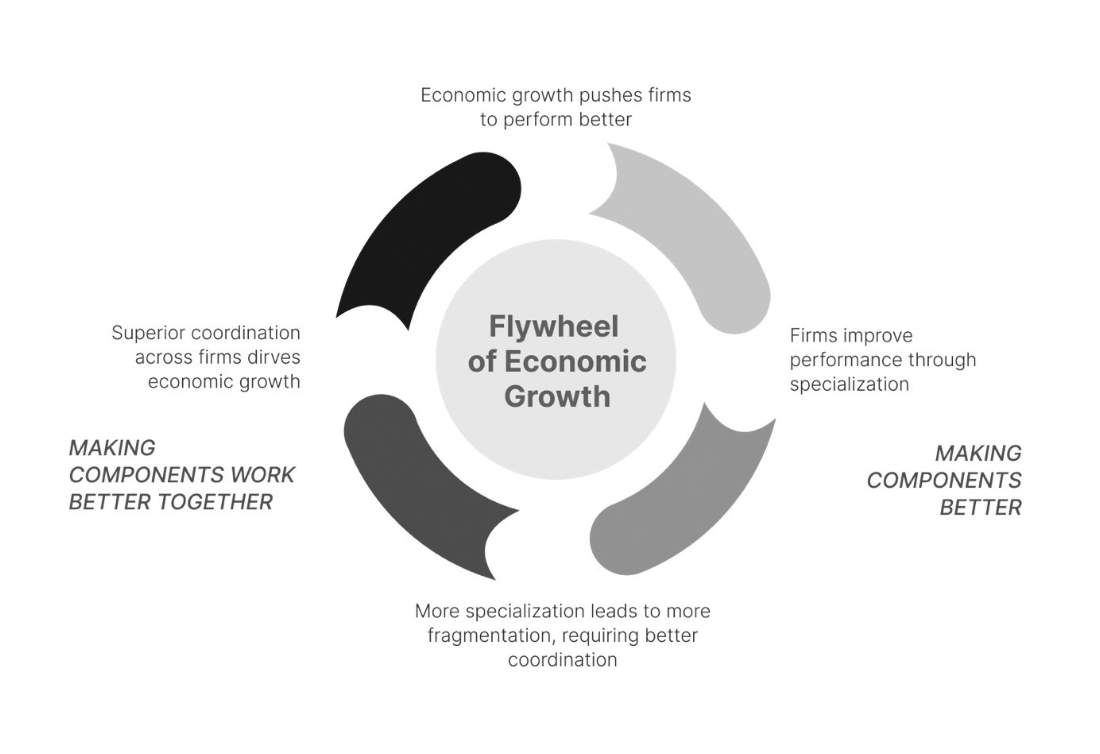
What might appear to be a copyright dispute or a struggle over web traffic is, in Choudary’s view, really a breakdown in coordination. His main argument is that, while publishers have little leverage individually during negotiations, their collective influence is substantial. Together, they provide the essential training material that makes large language models possible. Despite this, the industry has largely opted for isolated, one-on-one agreements with AI firms such as OpenAI, Google, and Anthropic. Those arrangements split the publisher group and hinder a shared sense of fair pricing. The Open Markets Institute’s 2025 report highlighted exactly this problem: when licensing is voluntary and bilateral, it leads to skewed data sets and an “information market failure.”
In the age of AI, publishers who help the rest of the ecosystem coordinate will be best positioned to capture value. That might mean acting as the verification layer that AI companies use to tether their outputs to reliable information. It could involve building systems that curate and contextualise AI-generated content for niche audiences. Or, it might be about setting up collective licensing markets that make it easier and cheaper for everyone to strike deals. The real value in all these cases isn’t just in owning exclusive content; it’s in removing friction from a system that desperately needs better alignment.
It’s a question of coordination, just as Choudary describes. Those who break out of the old model, fighting for small, one-off deals, and instead build the infrastructure that gives the industry as a whole greater leverage, will be the ones who thrive. If done right, efforts like SPUR aren’t just defensive moves; they’re the foundation for the next wave of value creation, exactly as Choudary envisions.
A language model trained only on the surviving major media outlets threatens the diversity of information, like a forest reduced to three trees: functional, but catastrophically fragile. Undermining local and specialised media not only deprives citizens of information; it also weakens the knowledge base that global AIs rely on. Destroying this foundation risks critical losses that may only become apparent when it is too late.
Response to major players who disdain collective action
The argument is well known: "Collective action rewards the small and asks the most of the large; in any such effort, the biggest players get the least back." This view deserves serious consideration and dismantling. First, there is an uneasy ecological truth for those in power. In any attempt at mutualisation or ecosystem regulation, the most powerful actors get the smallest marginal benefit. Why? Because they are already on top. They do not gain. Instead, they avoid future loss. Smaller actors secure immediate survival, while larger ones gain protection against long-term systemic risks. This is a thankless task, and that is why big players often undervalue this investment. But this is a short-term perspective rather than an economic reality. Here’s why:
- Dependence does not stay equal over time, even if it looks equal today. A large press group or AI platform may seem self-sufficient now. But its future strength depends on the health of the whole ecosystem. Big players plan further ahead, hold more assets, and face greater reputational risk. They have more to lose from a system collapse, not less.
- Collective action is not charity; it is the creation of shared infrastructure. When major players support common standards, pooled rights, or local press funding, they maintain the essential network that benefits everyone. Like mycorrhizal fungi connecting trees in a forest, this cooperation ensures the health of the entire system. This process isn’t about one tree helping another out of kindness; it’s about keeping the entire forest healthy, which every tree needs.
- Free-riding undermines both balance and legitimacy. The technological choices made today will determine tomorrow's dependencies. If major players do not collaborate, they risk having more restrictive rules imposed. It is more effective to help shape market rules than to be subject to them.
- Power without diversity is disguised fragility. In nature, dominant species thrive alone but become vulnerable to disease or drought. Monoculture, growing only one kind of crop, offers quick rewards but is risky in the long term. Stripping away variety, creating knowledge gaps, and relying on too few sources makes the whole system easier to break.
The true measure of a dominant actor is its ability to maintain a healthy and stable system. Ecosystem engineers, such as beavers or certain trees, create conditions that benefit others. In the media ecosystem, major players must decide whether to extract resources or invest in diversity and complexity. Collective action is not about the strong helping the weak, but about preserving the foundation on which all depend.
Shared standards are not merely bureaucratic "alphabet soup"
Standards are the invisible blueprints that determine whether a frontier technology serves as a foundation for growth or a trap for future failure. We thrive when we can cooperate on the basics rather than constantly negotiating them. Fundamentally, a standard represents the collectively agreed method for implementing technology. It is the specification that enables interoperability, such as allowing a nut from one manufacturer to fit a bolt from another.
The rejection of shared industry standards, such as those proposed by SPUR, poses significant risks to the long-term health of the news infrastructure. Building a healthy infrastructure requires shared standards for fairness and accuracy. If top-tier publishers opt out of these collective frameworks, the industry remains a "mess" of "computer-generated slop" and misinformation, making it harder for the public to find reliable alternatives.
- Lack of Technical Leverage: SPUR aims to simplify licensing between rights holders and AI developers, identify tools to protect intellectual property, and promote access to quality journalism through transparent and responsible channels. It also seeks to develop telemetry tools to monitor AI content usage after licensing. Without shared standards, publishers may have agreements but lack the technical means to verify proper use of their intellectual property.
- Fragmentation Empowers Tech Giants: Sulzberger notes that AI companies often "repackage stolen goods," diverting revenue and audiences. If major publishers do not join coalitions, tech giants can continue a divide-and-conquer approach, offering small, non-transparent licensing deals that undervalue content.
- Infrastructure for "Truth": A healthy news infrastructure depends on shared standards for fairness and accuracy. If leading publishers opt out, the industry risks being overwhelmed by misinformation and unreliable content, making it difficult for the public to access trustworthy information.
- Licensing Freedom: Members retain the right to enter into individual licensing agreements while benefiting from the coalition's technical standards.
As Sulzberger warns, the news industry is "smaller and weaker than two decades ago," while tech giants are "bigger and stronger." By remaining distant from collective initiatives like SPUR, publishers risk prioritising short-term autonomy over the long-term health of the civic commons and the sustainability of original reporting.