Weekly Digest, Issue #179, 27 June 2026
Why asking whether AI is better at our jobs than us is misleading: Shifting our view from thinking in terms of tasks to thinking in terms of systems

News under AI: Coordination is the next cycle of value.
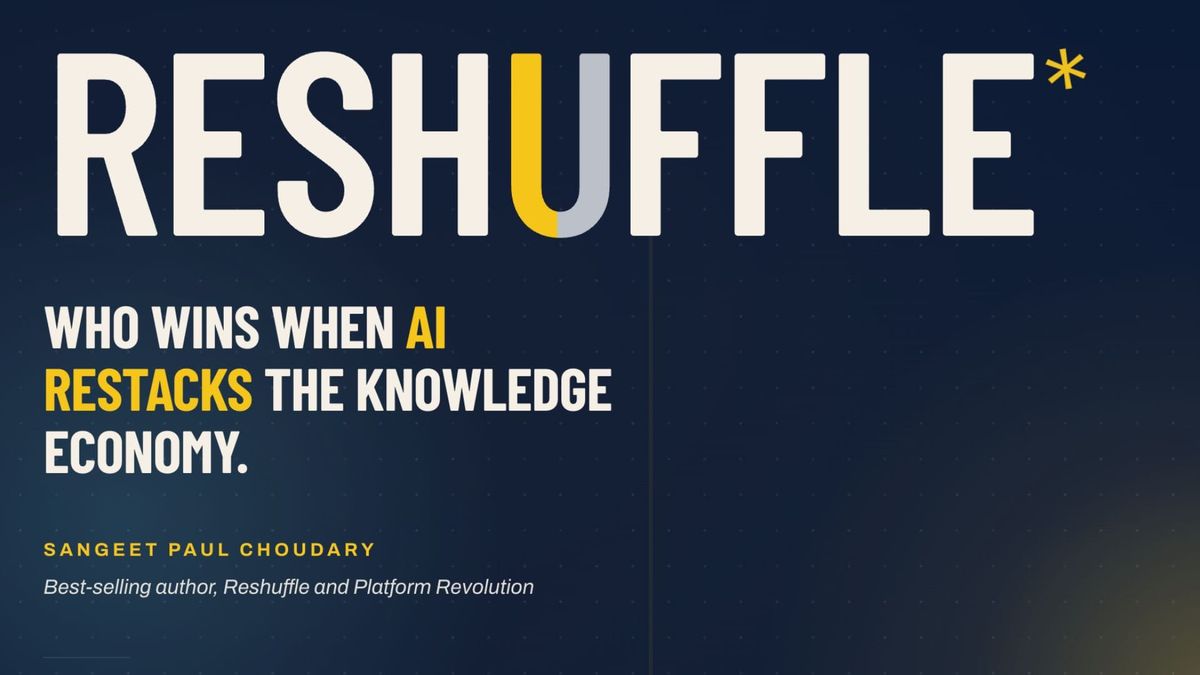
In Reshuffle, an essay published in the summer of 2025, Sangeet Paul Choudary reframes one of the most hyped technologies of our time not as a smarter brain, but as a better glue. Most of what you hear about AI right now is an automation read: Faster, better, cheaper. A productivity tool for work that already exists. But that distracts us from what's truly possible.
The more significant shift is that AI is a coordination technology, one that unbundles existing economic systems and rebundles them around new organising constraints.
He identifies three types of constraints that determine where economic value accumulates at any given time: scarcity (rare expertise), risk (liability and uncertainty), and coordination (the ability to align fragmented actors). His argument is that AI does not destroy value; it migrates it. When AI commoditises knowledge and expertise (dissolving scarcity constraints), value doesn't vanish; it flows toward whoever controls the new dominant constraints, which are almost always coordination and risk.
This is what he calls the "coordination tax", the friction cost that accumulates when actors cannot effectively align. Institutions that once thrived by hoarding expertise will rise or fall based on how well they reduce this tax for others. The strategic question shifts from "what can AI automate?" to "what new systems of work can AI coordinate, and who controls that coordination layer?"
His unbundling/rebundling lens is crucial here. AI first unbundles established value chains, breaking apart the integrated packages that incumbents relied on before those components are rebundled into new systems organised around different constraints. Whoever controls the rebundling layer controls the new economics.
How does this map onto the news publishing industry?
The news industry's situation under AI is almost a textbook illustration of Choudary's framework, revealing both the diagnosis and the strategic path forward.
The scarcity constraint that publishers held has collapsed.
For most of the past century, the value of news organisations rested partly on the scarcity of expertise: the journalists, editors, and institutional knowledge required to produce credible information at scale. AI is rapidly commoditising the production layer. Summarisation, aggregation, synthesis, and even basic reporting are increasingly within reach of frontier models. This is the unbundling moment Choudary describes. The old integrated bundle - gather, produce, package, distribute - is coming apart.
The coordination failure is the actual crisis.
What looks like a copyright crisis or a traffic crisis is, through Choudary's lens, fundamentally a coordination failure. Publishers are individually weak at the negotiating table, but collectively powerful. They collectively represent the training data substrate that made large language models viable in the first place. Yet the industry has largely pursued fragmented bilateral deals with AI companies, with OpenAI, Google, Anthropic, and others signing selective agreements that divide the publisher base and prevent collective price discovery. The Open Markets Institute's 2025 report flagged precisely this: voluntary, bilateral licensing produces biased datasets and an "information market failure."
The SPUR coalition, launched in early 2026 by the BBC, Financial Times, The Guardian, Sky News, and Telegraph Media Group, is the most visible attempt to solve this coordination problem through collective infrastructure: shared metadata standards, unified licensing frameworks, and an aligned bargaining posture. This is, in Choudary's terms, the rebundling move: reassembling fragmented publishers into a coordination layer that can actually negotiate against the asymmetric power of major AI labs.
Value is migrating toward curation, trust, and judgment.
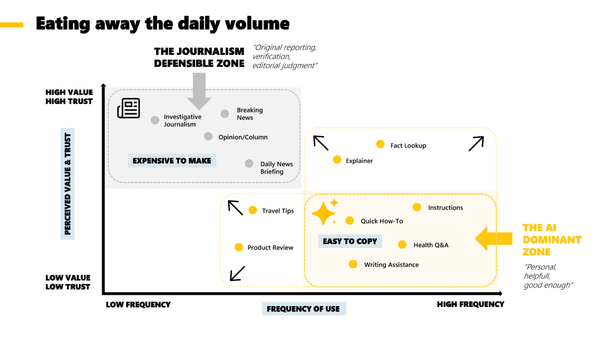
The value-creation chain (curiosity, knowledge, curation, judgment) points to where publishers should compete. Knowledge (raw information) is being commoditised; this is where news organisations are bleeding. But curation (what matters, in what context, for whom) and judgment (what to make of it) remain deeply hard to automate credibly. Publishers that rebundle around these higher-order functions, becoming coordination hubs for trusted, contextualised intelligence rather than raw content factories, are better positioned.
Choudary also points out that risk is an area where value is shifting. News organisations have spent years developing legal, editorial, and reputational safeguards that AI labs lack and cannot easily replicate. As AI companies face greater liability for misinformation, hallucinations, and defamation, publishers who act as trusted, accountable sources of information offer a valuable risk-reduction service. In a world where AI-generated content can create reputational and regulatory problems, this function has real economic value.
Who can reduce the coordination tax, wins.
Choudary's framework suggests that the publishers most likely to capture value in the AI era are those who solve coordination problems for other actors in the ecosystem. That could mean becoming the verification layer that AI companies license to ground their outputs in trustworthy sources. It could mean becoming the curation infrastructure that aggregates and contextualises AI-generated content for specialised audiences. It could mean building collective licensing marketplaces that lower the transaction cost of content deals for both sides. In each case, the value comes not from owning unique content per se, but from reducing friction in a system that badly needs alignment.
The broad implication is that the publishing industry's AI problem is not primarily a copyright problem (though copyright matters as a lever). It's a coordination problem that mirrors the exact dynamic Choudary maps. The publishers that will navigate this well are the ones that stop competing individually for bilateral scraps and instead build the coordination infrastructure that makes the whole industry's content worth paying for. Done right, SPUR and its equivalents aren't just defensive alliances; they're the rebundling layer that Choudary would say captures the next cycle of value.