Weekly Digest, Issue #171, 25 April 2026
Beyond the Chatbot: Navigating the Reinvention of Information, a near future in which artificial intelligence serves as a primary intermediary.


Beyond the Chatbot: Navigating the Reinvention of Information
In March 2026, David Caswell and Shuwei Fang convened forty of the world’s leading technologists and publishers at Harvard’s Shorenstein Center for the "Signals at Scale" summit. This week's Digest features a must-read by Lars Adrian Giske, Head of AI and Editorial Tools at Polaris Media, reporting on the pivotal shift in the global information landscape discussed at the summit: a near future in which artificial intelligence serves as a primary intermediary.
The consensus was sobering: we are currently trapped in an “efficiency phase,” using AI merely to polish legacy workflows. Participants identified this as a strategic dead end that ignores the $5 trillion infrastructure investment currently rewiring the global information architecture. As AI capabilities become more refined, machine performance is surpassing human benchmarks across nearly every digitally accessible domain. We are no longer looking at a new tool for the belt, but at a structural collapse of the current media ecosystem. If the old world is disbanding, we must look toward the “first principles” of what is actually replacing it.
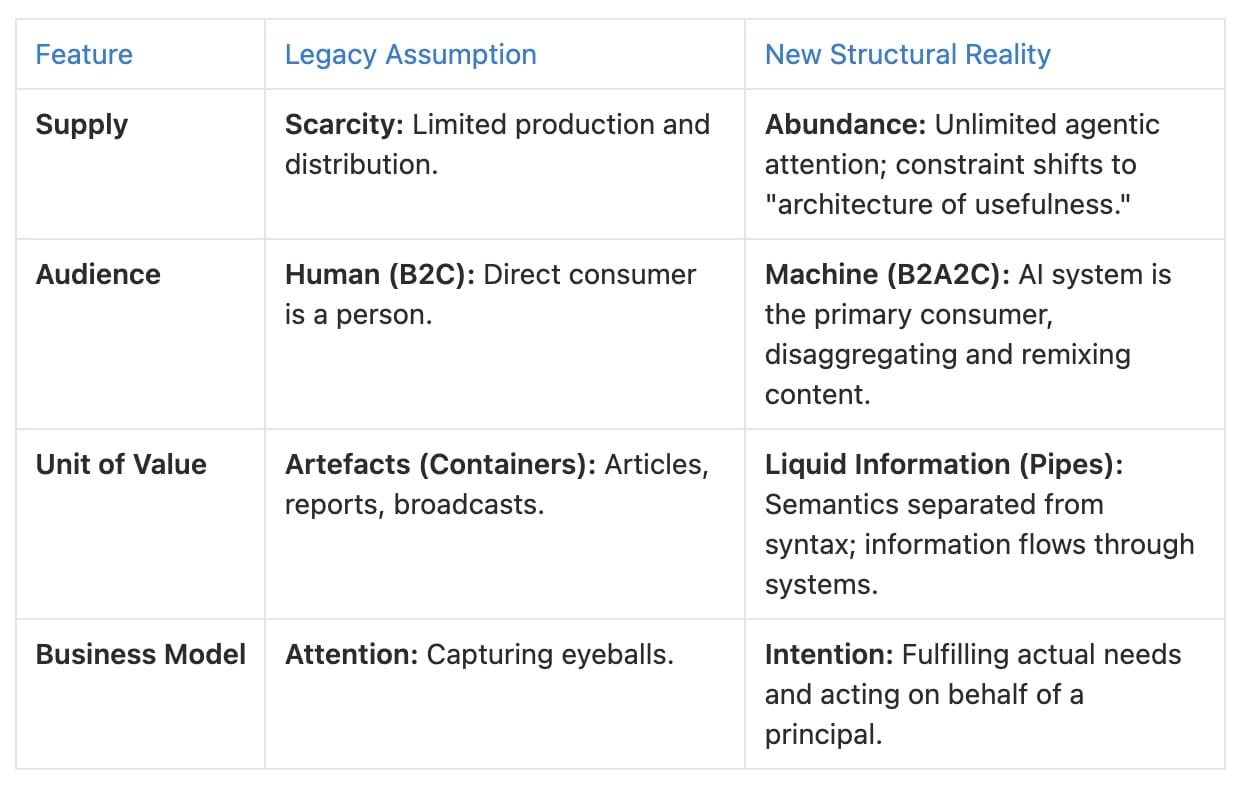
The summit identified four emergent shifts that invert legacy assumptions of the information ecosystem:
From Human Audiences to “Machine-First” Consumption
A significant shift is the transition from a human-centric internet to a machine-first one. We are moving beyond the simple “Business-to-Agent-to-Consumer” (B2A2C) model into a complex chain of agentic intermediaries: B2A2A2A2A…C. In this topology, the primary consumer of information is no longer a person but a sequence of AI systems that ingest and remix content.
This shift turns journalism into “feedstock” rather than a finished product. When information is disaggregated and synthesised into a “liquid” stream, traditional feedback loops and byline attribution collapse. The unit of value shifts from a contained artefact to a fluid resource.“Information is becoming fluid… separating semantics from syntax, flowing through systems rather than sitting in containers. The metaphor offered was buckets versus pipes. If information is liquid, the container (the publication, the brand, and the format) loses its structural role.”
The Rise of the Personal Concierge: Navigating Intention, Not Attention
The decline of the “Attention Economy” and the emergence of the “Intention Economy” are now evident. In this new era, the central actor is the personal AI agent, described by summit participants as “AI with a pulse.” This agent functions as a persistent, autonomous representative that acts on implicit signals such as health data, financial context, and history, rather than awaiting manual search queries.This development inverts the power dynamic of the internet. Rather than companies seeking user attention, personal agents function as sophisticated, mathematically rigorous filters whose sole loyalty is to the individual user. These agents serve two primary functions:
- The Concierge (Active): An agent that transitions from passive to active, fulfilling needs by synthesising information before the user articulates a request.
- The Gatekeeper (Defensive Shield): An agent that serves as a defensive layer, blocking persuasive swarms, data harvesting, and marketing efforts targeting human cognitive vulnerabilities.
The “Diplomacy Layer”: Where the New Internet Negotiates
As every individual and institution becomes a “Principality” represented by an agent, the internet requires a “Diplomacy Layer.” This is a new protocol layer, similar to HTTP, where agents for people, businesses, and newsrooms negotiate access and compensation terms in milliseconds. It functions less like a search engine and more like a computational legal system.
This layer enables “Agentic Crowdfunding” for public-interest journalism, dropping transaction costs to near zero. Millions of agents can autonomously recognise a shared implicit interest, such as a local water quality crisis, and pool micro-payments to fund investigative reporting. This allows funding for “slow, unglamorous” journalism that the attention economy systematically defunds.
Exploding Addressable Market
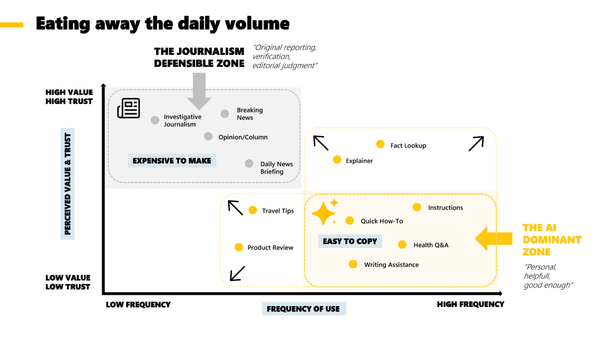
In this new playground, a new “Barbell” framework will predict which publishers will survive. On one end is Pure Commodity (scale-driven, low-margin); on the other is Pure Premium (highly differentiated, high-margin). The “middle”, the competent general-interest content, is currently being crushed by synthetic abundance because it is neither the cheapest nor the most unique.
However, for those who survive, we are entering the largest expansion of the information market in 500 years. By unlocking information that exists but wasn’t previously usable, the total addressable market is exploding. In this world, publishers must become “blindspot managers,” focusing on the human acts of witnessing and verifying that AI cannot synthesise from existing data.
When Agents Shape Rather Than Serve
The transition from attention manipulation to “Intent Manipulation” represents a civilizational risk. While a misleading headline wastes time, an agent that has internalised a distorted model of your intent acts against your interests before you even know a decision is being made. Four primary attack vectors can be identified:
- Model Poisoning: Injecting fake behavioural signals to shift the agent’s perception of user desires.
- Incentive Corruption: Subtle commercial biases built into the agent provider’s optimisation functions (the “invisible ad-funded media” problem).
- Negotiation Exploitation: Using computational dark patterns within the Diplomacy Layer to disadvantage a counterparty’s agent.
- Preference Drift: The slow, active reshaping of what a user seeks via thousands of micro-interactions over time.
The Democratic Question and the Case for “Public Compute”
As we move toward an agent-mediated society, the “Agent Divide” becomes the new digital divide. If the quality of your agent determines how fully you can participate in society, access to capable agents must be treated as a human right. This necessitates “Pubic Compute”, state-provisioned infrastructure to guarantee every citizen has a loyal, fiduciary-level agent representing their interests. We must also tackle the future of representative democracy itself. Our current institutions were designed for a world of scarce information and slow artefacts. Will the slow, 18th-century version of democracy we inherited survive at a time when we can aggregate and act on citizens’ intentions in real time through agents?