Weekly Digest, Issue #187, 25 Oct 2026
elink.io | See Original
elink.io | See Original

Independent journalism in Europe is a challenging business, but a viable one. With modest, patient, largely non-VC funding, a sustained focus on audience revenue, outlets across the continent have built substantial businesses generating €2–8 million, some of them genuinely profitable.

The SPUR initiative published the first official version of its content telemetry standard. It generates verified usage data that publishers can use as an objective baseline in commercial licensing negotiations.
AI is reshaping how society produces, verifies, distributes, and consumes information. The transition to an AI-mediated information ecosystem is inevitable and accelerating. The next two to three years are critical for establishing the standards that will govern information for generations.

Polaris Vest’s tiny newsrooms are currently out-innovating global giants. By refusing to succumb to the "wait-and-see" trap, Polaris Media's regional branch has transformed from a collection of small-town outlets into an agile pioneer in AI implementation.

AI Overviews reduced search referrals to Wikipedia by about 5%, according to a University of Washington paper. Wikimedia shares data on articles in many languages, and the paper compares matching pages across different language editions. Most websites can’t make these kinds of comparisons.
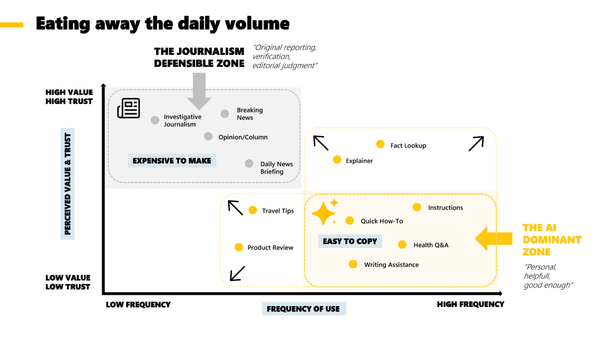
Stop trying to be an "AI company". The future belongs to "OI companies" that treat first-hand origination as their primary asset and use AI merely as a tool to scale it.

Mather Economics data challenge the notion that platform disruption (e.g., changes in social media or search algorithms) is the sole cause of audience decline.

Why asking whether AI is better at our jobs than us is misleading: Shifting our view from thinking in terms of tasks to thinking in terms of systems
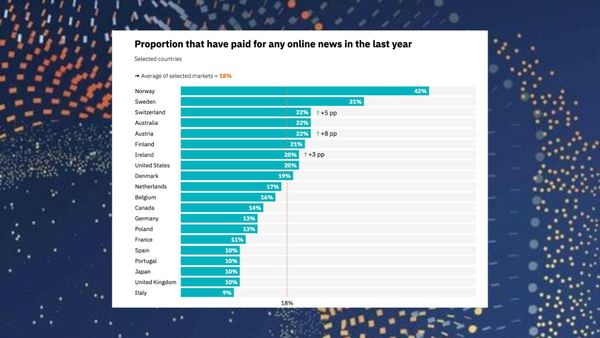
The Reuters Institute's DRN report identifies 2026 as a milestone year in which pathways between journalism and the public have become less direct and more fragmented. Audiences are increasingly drifting away from "owned and operated" branded properties.

The overwhelming majority of AI citations (approximately 84%) come from earned media. Paid and advertorial content is virtually non-existent in the citation ecosystem, accounting for a mere 0.3% of links.

In the media ecosystem, major players must decide whether to extract resources or invest in diversity and complexity. Collective action is not about the strong helping the weak, but about preserving the foundation on which all depend.

AI agents increasingly mediate the relationship between publishers and audiences. However, emerging technical protocols, alongside global collective licensing efforts, offer a framework for publishers to reclaim authority and secure compensation.

The emerging market for AI content licensing is forming under conditions that mirror the structurally damaging relationships previously established between news publishers and search/social media platforms.

The publishers positioned for the AI moment are the ones who did the structural work before the moment arrived. Most newsrooms didn't.
The news industry isn't declining; it's being repriced, argues Francesco Marconi in his latest essay.

Beyond the Chatbot: Navigating the Reinvention of Information, a near future in which artificial intelligence serves as a primary intermediary.

The FT argues that while social media has fueled populism and polarisation by amplifying fringe voices, artificial intelligence may have the opposite effect.

Contrary to popular belief, a Mather Economics analysis suggests that while organic search is declining, this trend is part of a broader, multi-channel contraction affecting social and direct visits alike.

The transition toward an "agentic economy", one driven by autonomous AI agents, requires a fundamental shift in how technology is governed and structured.
The Future Today Strategy Group's Convergence Outlook 2026 proposes a framework of interconnected systemic change, arguing that isolated technological or social shifts no longer exist.
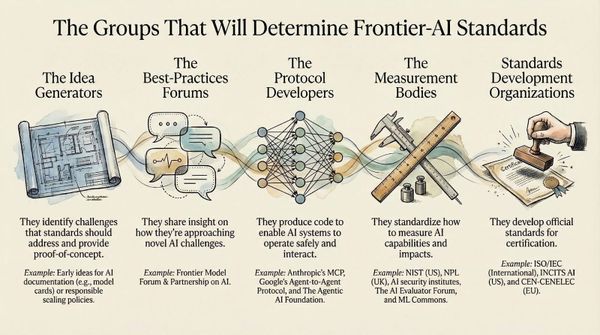
Standards are not merely bureaucratic "alphabet soup"; they are the invisible blueprints that determine whether a frontier technology serves as a foundation for growth or a trap for future failure.

Expanding the Publisher’s Customer Surface in the AI-casting Era. The shared incentives that once supported quality journalism during the era of navigational and transactional search are now being replaced by AI-native exploratory queries. This change does more than just lower website traffic; it makes the old publisher

The Nordic High-Trust Model is Defying the Digital Gravity of Big Tech. The Nordic region is widely seen as a global role model for democratic health and media freedom. While many countries face increasing polarisation and digital disruption, these five nations have maintained notable social cohesion. However, they are